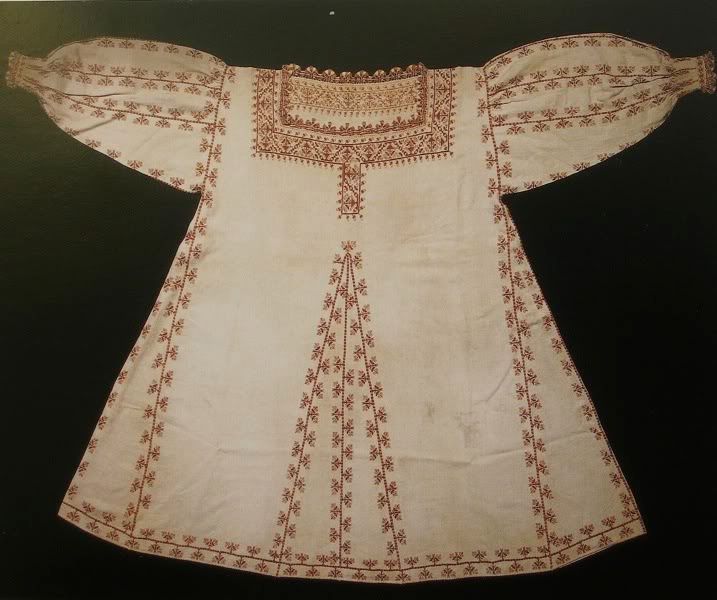
The coat and camica are done! Yay! The client came last night for a fitting last night and the coat itself fit well and she was quite happy, but I had failed to up underarm gussets in the camica, which turned out to be desperately needed, so I put those in this morning. That's what happens when you make a thing in 3 days with no chance for a fitting. It's much better now, and we were able to get it placed well enough to see that the neck draping will work perfectly. I may actually have the neck a little too wide, but that should be easily solved with a few pins. It will work out perfectly if she ever decides to do an actual Italian gown.
Sadly, in the joy of finishing the blasted project, I failed to take a picture. Not that it fits properly on my dress form anyway, about the only thing that would would be a costume from Downton Abby. I will get a picture of the whole thing this weekend though.
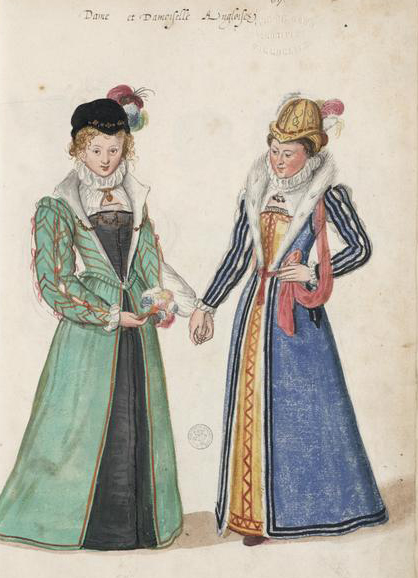
In other later-period costuming news, Kendra at Demode posted yesterday about a fantastic resource for those of you/us interested in 16th century costume. She found a scanned PDF of a book by Lucas de Heere with some really fantastic illustrations of contemporary costume, a couple of which I have not seen before (and I have done a lot of research into this period from my Faire days). What's really great about de Heere is that he's drawn common people, not just the aristocracy.
Thursday, January 12, 2012
Saturday, January 7, 2012
Turkish Coat Progress!
The coat is coming along nicely! Last night I did the fitting and everything fit, which was a relief. Not that I don't trust my measuring and patterning skills, but it's always a bit scary when there is so little time to fix major problems. The sleeve looked great, I am very glad I went with the more fitted shoulder and sleeve shape. I think it will make a huge difference in the overall look of the finished coat, especially in the fabric, which is rather on the stiff side.So, today I put the rest of the coat together, got the button holes made (by machine, I really think they should be button loops but I don't have time to make them that way), and tonight I will be doing the hand sewing. I have to sew on the trim, finish sewing on the buttons, and sew the hem. Not so bad really.
I am sort of debating about the trim. There is not enough the gold and pearl trim to do the fronts, but I can use it for the sleeves. I have plenty of the gold giump style braid, but it's a bit plain for the brocade. Either way, the fabric is rich enough (the pictures don't show it off too well) that the trim will just finish off the edges and add a bit of depth to the whole thing. I can't decide if I should just use the braid, or go ahead and use the pearl trim on the sleeves and the braid on the coat neck and down the front. I think using both might look a little funny, especially with the richer trim on the sleeve where it won't be as noticeable.
Any ideas?
Friday, January 6, 2012
New turn shoes
My 12th Night present to myself arrived today - a pair of brand new bright red 14th century styled turn shoes! yay! This is my first pair of proper turn shoes and I do think they are going to take a little getting used to and breaking in, not having any arch support in the shoe to speak of is quite different than modern foot wear, and the bottom is very slick. Without the usual rubber bit on the heal of modern shoes, this might get tricky on carpet on certain linoleum floors. I ordered them from revival.us and am very happy all around. I think the color will look smashing with my green hose and blue garters! Now I just need to find/make/find someone to make for me some wooden pattens and I am all set.
Not much else going on to report...I made very little notable progress on the Turkish coat yesterday. I've decided to go with the Greenland/grand asiette style sleeve, as this makes more sense to me and will look better. The sleeves are cut, I've got the sleeve opening cut, the facings (I'm not lining the coat, it's made from upholstery polyester and she will roast to death with a lining, I did not pick the fabric) are attached and sewn down. Tonight I will fit the coat and figure out where the side gores need to be, tweak the waist and side seams, and mark the hem and hopefully finish this thing over the weekend. Then I can make the camica and be done! Hurray! Oh...the trim. There is trim. And buttons. Which I do not have yet. Sigh. It's always something.
Thursday, January 5, 2012
Venetian Coat Sleeves
Work is coming along on the Venetian coat. I've got it cut out (always an important first hurdle to overcome) and the center back gore is put in. I went with a basically rectangular construction, based on the pattern for Ottoman style coats given at the Renaissance Tailor because this seems plausible and I don't really have time to do a great deal more research. I did however skip the weird underarm gore thing, partly because I don't have time to figure this out and also because it does not make sense that this is how the Venetian version of the coat would be cut.
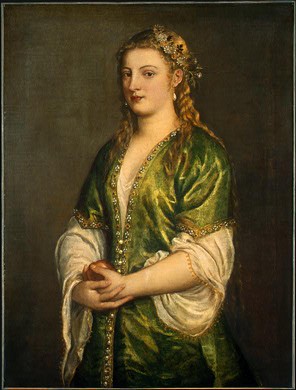
Here is my thinking...the lady in the Titian portrait is clearly NOT wearing actual Turkish clothing. The fabric is plain satin, which as far as I know was not a big thing in the Ottoman Empire at the time, the trim is wrong, and the fit is more constructed that what you see in the few illustrations of contemporary coats I've looked at. So, my thought is this is an Italian interpretation of what the Ottoman's wore, and thus cut more like Italian cloths. Given that, I've cut the body of the garments in two rectangles with triangular gores at the sides and center back, which squares with how similar robes are cut in Janet Arnold (sort of, it's at least plausible and makes good use of the fabric).
Which brings me to the sleeves and upper body. The original coat the lady I am making this for made is cut just like your basic early period tunic, with honking big gores under the arms (see the picture). This is all well and good, but produces a much looser look around the upper body than you see in the Titian painting, and as far as I know wasn't a commonly used construction method in the 16th century. So...what to do? A shaped armscye? Something more like the grand asiette style sleeve I've used in my fitted gowns, but looser fitting? Clearly some sort of set in sleeve is called for, the question is weather I want/need to use the gore in the back, and how set in it should be.
Here is my thinking...the lady in the Titian portrait is clearly NOT wearing actual Turkish clothing. The fabric is plain satin, which as far as I know was not a big thing in the Ottoman Empire at the time, the trim is wrong, and the fit is more constructed that what you see in the few illustrations of contemporary coats I've looked at. So, my thought is this is an Italian interpretation of what the Ottoman's wore, and thus cut more like Italian cloths. Given that, I've cut the body of the garments in two rectangles with triangular gores at the sides and center back, which squares with how similar robes are cut in Janet Arnold (sort of, it's at least plausible and makes good use of the fabric).
Which brings me to the sleeves and upper body. The original coat the lady I am making this for made is cut just like your basic early period tunic, with honking big gores under the arms (see the picture). This is all well and good, but produces a much looser look around the upper body than you see in the Titian painting, and as far as I know wasn't a commonly used construction method in the 16th century. So...what to do? A shaped armscye? Something more like the grand asiette style sleeve I've used in my fitted gowns, but looser fitting? Clearly some sort of set in sleeve is called for, the question is weather I want/need to use the gore in the back, and how set in it should be.
Monday, January 2, 2012
Acid dye fun and Venetian dresses
I've got a total of 8 ounces in the each colorway, so there should be enough to so something of real significance with either color. Not a sweater, my dye pots aren't large enough for sweater quantities of roving anyway, but scarves and mittens and hats and things are certainly workable. Next up, more indigo! I need to do some cotton for my long-delayed Perugia towel project and some silk to compare the results.
In sewing related news...not much going on other than knitting needle cases and bags, but I am working on a Venetian Turkish coat thing for our local Baroness for 12th Night. It's all a bit last minute, but I think it will turn out nicely. The only thing I'm a little worried about is the camica layer. I think (?) it's just a regular old camica, but I have not done a lot of research on 16th century Venetian clothing so I'm not really sure how this should be cut so that it's reasonably correct, looks like the picture, and will not result in any unfortunate wardrobe malfunctions (mostly the last one).
I know there is a surviving Tuscan camica from the same period that is square-necked and cut roughly the same way as your basic tunic, but with but pooffy sleeves. This seems like it might be a good way to go. The Titian painting does not seem to show a heavily gathered (or gathered at all) neck line on the camica, just some loose drapes as though the shoulders are pulled up further than they are meant to sit. With the squared neck and some judicious pinning to avoid any unfortunate and untimely slippage, I think the right affect could be achieved.
Tuesday, December 20, 2011
*ded*
Somehow or another I have managed to actually start a very small, itty bitty business! And the Christmas rush has been driving me nuts! That's what they don't tell you about working for yourself...it's all "you can set your hours" (not mentioning that they will be 7 days a week) or "you can work in you PJs" (because you won't have time to put on real pants). November was a good first month, December has been even better, and I'm hoping to keep the ball rolling into the New Year now that I have some product ideas that people seem to actually want. Yay!
Not that this has anything to do with this particular blog. :) Except that I am thinking about doing some hand dyed rovings, so that's sort of relevent. Kind of.
Anyway...I am exhausted! And totally ba-humbuging the whole holiday thing. Tomorrow should be the last day for orders I *must* get mailed, so then I can rest a little, maybe bake some cookies and try to get into the Christmas spirit, or at least into the I-don't-want-cry-I'm-so-tired spirit. Then maybe, just maybe, I will have time to actually make something new for 12th Night.
I ordered some really gorgeous new wools from Fabric.com last week (? I think?) when they were on sale for $4.99 a yard. Of course, I feel so fat and repulsive right now, the idea of making a dress out of such pretty fabric seems terribly wasteful, and I do have my blue linen houp I can wear. Maybe with the new hat I've been planning.
We'll see.
First, a nap. And some eggnog, heavy on the rum! :)
Not that this has anything to do with this particular blog. :) Except that I am thinking about doing some hand dyed rovings, so that's sort of relevent. Kind of.
Anyway...I am exhausted! And totally ba-humbuging the whole holiday thing. Tomorrow should be the last day for orders I *must* get mailed, so then I can rest a little, maybe bake some cookies and try to get into the Christmas spirit, or at least into the I-don't-want-cry-I'm-so-tired spirit. Then maybe, just maybe, I will have time to actually make something new for 12th Night.
I ordered some really gorgeous new wools from Fabric.com last week (? I think?) when they were on sale for $4.99 a yard. Of course, I feel so fat and repulsive right now, the idea of making a dress out of such pretty fabric seems terribly wasteful, and I do have my blue linen houp I can wear. Maybe with the new hat I've been planning.
We'll see.
First, a nap. And some eggnog, heavy on the rum! :)
Wednesday, November 30, 2011
Our new baby
I've been fairly busy the last couple of weeks working on things for my fledgling business, trying to get stock made up, filling orders, and coming up with new things to try. That hasn't let a lot of time or energy for historical sewing, but I'm hoping that once things settle down a bit I'll be able to establish some sort of new routine. It doesn't help that now that I'm fairly certain that I *can* weave, my loom room has been taken over by the newest addition to the household, the as-yet-nameless kitten. The DH wants to call her Patches, but I have an aversion to naming animals silly words rather than actual names. She was called Ellie at the pound, but that's the name of a friends dog, so that won't do. Right now I'm leaning towards Annie. So far we've been calling her Miss. Kitty Fantastico until we come up with a real name.
It's been a rough fall. Ok, to be honest it's been a rough year or two but I think the last couple of months have really been wearing on me. Not being able to get out of the house since the the surgery and having so much trouble doing even basic things, on top of the pain, the cat dying, and everything else has just got me down. Usually I try not to post about personal things here, but part of my lack of productivity and progress with some of my projects is that I'm feeling really discouraged in general. Working so hard and seeing so little return for it is frustrating, and it seems like that's what I've been doing on all fronts lately.
Wednesday, November 9, 2011
Rewind please?
What a miserable week. I went to California for a jewelry show last week, something totally outside the scope of this particular blog but I've been trying to see if I can make profitable over the last few months. The show did not go well, but I'm not really sure why. It didn't seem like any of the vendors there were selling much, so as far as a learning experience goes it was kind of not that helpful.
Business matters aside, the trip sort of went down hill from there. Trying to get home on Sunday, the plane I was supposed tot ake out of LAX developed some sort of water leak and the flight got canceled, leaving me stuck in LA for 11 extra hours, with another 5 hour layover in Miami. When I did finally get home Monday afternoon (only 17 hours late and not having slept or eaten properly) I found my cat sitting on the living room floor in a puddle of her own urine and unable to stand up. The vet did what she could but she (the cat, not the vet) ended up having to be put to sleep yesterday morning. According to the DH Maya (the cat) had been acting strangely for the last couple of days and he hadn't seen her move on her own since before Saturday. I feel awful that I wasn't there for her, not that I could have done anything. Poor old kitty.
Anyway, the trip wasn't a total fiber waste. I did stop by Village Spinning Weaving and get some more Gotland for my never-ending warp spinning project. I'm trying to spin up enough to weave either an apron dress or one of the short sleeves Greenland dresses. So far I have 3 shades of Gotland for the warp, but I think if I warp carefully that won't be a problem. I will need to make sure I get all the same color wool for the weft or I'm going to have a crazy checked dress. I also got some bamboo to try out for tablet weaving. It's much less expensive than silk, making it less scary to work with and get wrong, but has a fairly similar hand so it should (I hope) work up better than the cotton I have been using for the London bands. I want to make a filet, similar to the one in the MOL book with the bits of fake hair still attached. That particular band did not work at all well with the cotton so hopefully the bamboo will improve things. Once I get the hang of things a little better I will move on to silk, I'm just not brave enough yet to spend that kind of money on a learning project.
Business matters aside, the trip sort of went down hill from there. Trying to get home on Sunday, the plane I was supposed tot ake out of LAX developed some sort of water leak and the flight got canceled, leaving me stuck in LA for 11 extra hours, with another 5 hour layover in Miami. When I did finally get home Monday afternoon (only 17 hours late and not having slept or eaten properly) I found my cat sitting on the living room floor in a puddle of her own urine and unable to stand up. The vet did what she could but she (the cat, not the vet) ended up having to be put to sleep yesterday morning. According to the DH Maya (the cat) had been acting strangely for the last couple of days and he hadn't seen her move on her own since before Saturday. I feel awful that I wasn't there for her, not that I could have done anything. Poor old kitty.
Anyway, the trip wasn't a total fiber waste. I did stop by Village Spinning Weaving and get some more Gotland for my never-ending warp spinning project. I'm trying to spin up enough to weave either an apron dress or one of the short sleeves Greenland dresses. So far I have 3 shades of Gotland for the warp, but I think if I warp carefully that won't be a problem. I will need to make sure I get all the same color wool for the weft or I'm going to have a crazy checked dress. I also got some bamboo to try out for tablet weaving. It's much less expensive than silk, making it less scary to work with and get wrong, but has a fairly similar hand so it should (I hope) work up better than the cotton I have been using for the London bands. I want to make a filet, similar to the one in the MOL book with the bits of fake hair still attached. That particular band did not work at all well with the cotton so hopefully the bamboo will improve things. Once I get the hang of things a little better I will move on to silk, I'm just not brave enough yet to spend that kind of money on a learning project.
Sunday, October 30, 2011
Hat problem solved!
Maybe anyway...
The stiffening issue for my truncated hennin style hat has been really bothering me. I was trolling around the forums on Ravelry today for no particular reason (avoiding packing/laundry/cleaning) and stumbled across a post about some earlier period Spanish hats called toca. The relevant point is that they were stiffened with paper! Vellum to be exact, and there actually is one extant! Hurray! There is a good paper about recreating one here. The vellum makes so much more sense to me, especially after looking at the Spanish hats and the similarity in shape (somewhere between the hennin and a bishops miter).
That being said, I think using paper is not the best plan for durability sake and I don't really know if I want to try to track down vellum, so I will probably still use buckram. At least I now I have a better idea of some plausible base materials though, and that makes me feel better. I'm not making a modern substitution blindly.
The stiffening issue for my truncated hennin style hat has been really bothering me. I was trolling around the forums on Ravelry today for no particular reason (avoiding packing/laundry/cleaning) and stumbled across a post about some earlier period Spanish hats called toca. The relevant point is that they were stiffened with paper! Vellum to be exact, and there actually is one extant! Hurray! There is a good paper about recreating one here. The vellum makes so much more sense to me, especially after looking at the Spanish hats and the similarity in shape (somewhere between the hennin and a bishops miter).
That being said, I think using paper is not the best plan for durability sake and I don't really know if I want to try to track down vellum, so I will probably still use buckram. At least I now I have a better idea of some plausible base materials though, and that makes me feel better. I'm not making a modern substitution blindly.
Saturday, October 29, 2011
Advice
I need a new dress form. I have one. She is lovely. She is about 100 years old (literally, we can roughly date her to 1910 or so), which has it's uses but has a lot of draw backs too. The silhouette is all wrong for modern bodies and and I'm not really willing to corset her or pin into her to reshape her. Because she is old. I'd like to stop using her she will last longer as an antique and get a new, more adjustable, right-shaped dress form. The adjustable thing is important as I am really trying to loose some of the weight I have gained since my car accident, and now that I'm in the post-op world that should start getting easier rather than progressively harder. Plus I do sew for other people, in a small space, so the adjustable thing would come in handy when working for clients (so long as they fit within the size range for the form).
I've seen some forms at my local Hancock and Joann's which look like they would be ok for my current purposes priced at around $100, depending on the current sale. I think they are made by Dritz. Has anyone had any experience with these? Are they a total waste of money? They don't like like they would hold up a 45 pound houppeland terribly well on the adjustable stand, but I would think some clever use of PVC pipe would solve that problem. I've never found an adjustable stand that *would* hold up such a gown (at least not for long), even when I had the luxury of using industrial forms.
Monday, October 24, 2011
More hat pondering
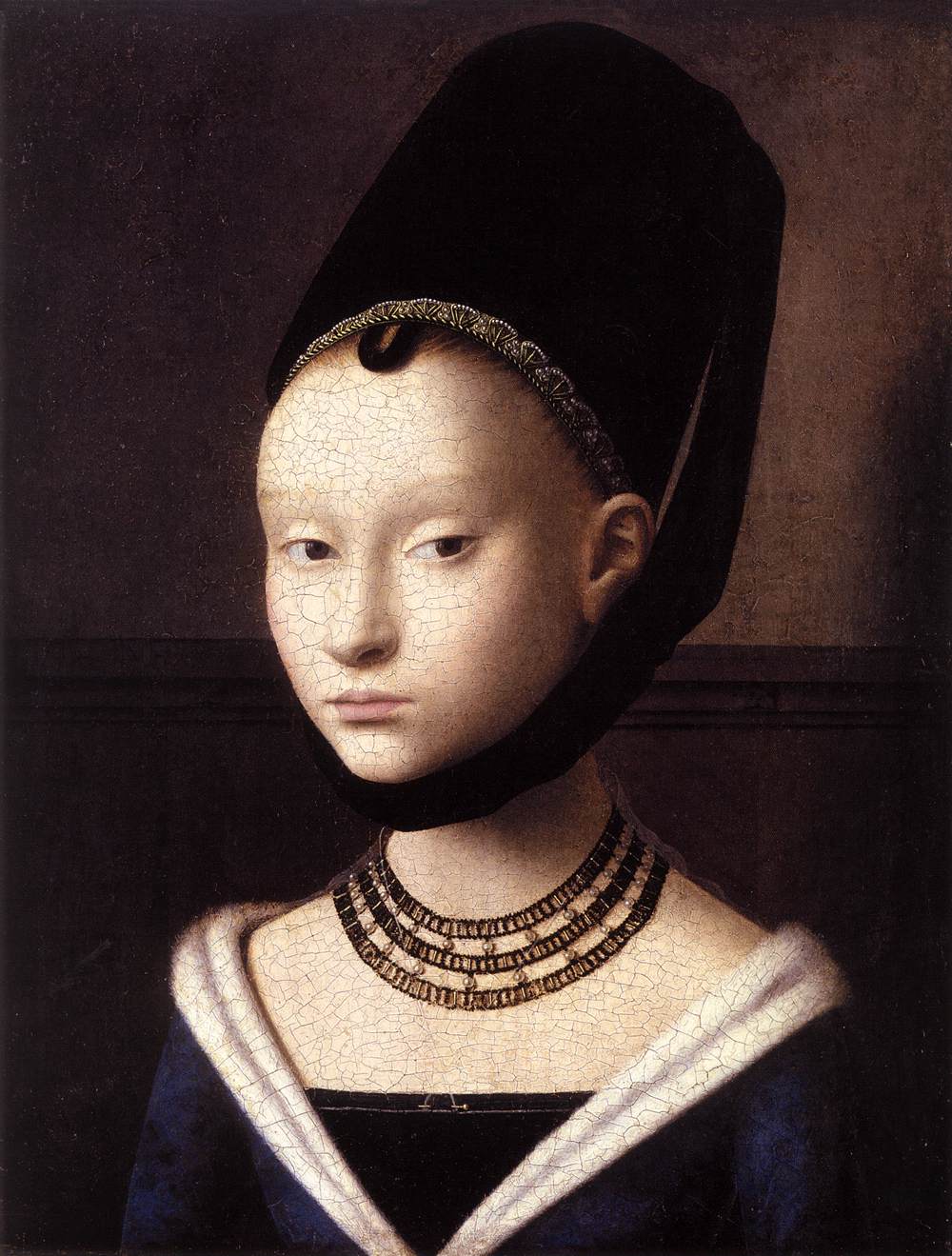
| Petrus Christus, after 1460, Portrait of a Young Girl |
What bothers me about this argument though is that many, if not all, of these cone type hats seem to be covered with fabric (though I can think of one that sort of looks like woven ribbons or a basket type surface, it's hard to tell). Covering woven straw or reeds with delicate fabric seems like a bad plan, as the straw would wear through some of the clearly very delicate cloth that's on these hats. Sure, you can pad it out to protect the cloth, but that makes for a pretty chunky looking hat.
I don't know. I have a lot of buckram so since I have that to hand and am not entering that hat in an A&S competition, I'm going to use that for the first version of the hat. I've always loved the simplicity of the hat in the Christus portrait, and the neck drape is all kinds of fun, so I might go with that look instead of the more formal gold thing in the original painting I'm basing the actual dress on. The black hat strikes me as less formal somehow, which I think would work better with my wool gown. The dates on the paintings are close enough that I don't think it will be a problem, plus the hats are very similar in shape and sitting in the same position on the head (the gold hat is a little more rounded in shape) so the style doesn't seem to have changed much.
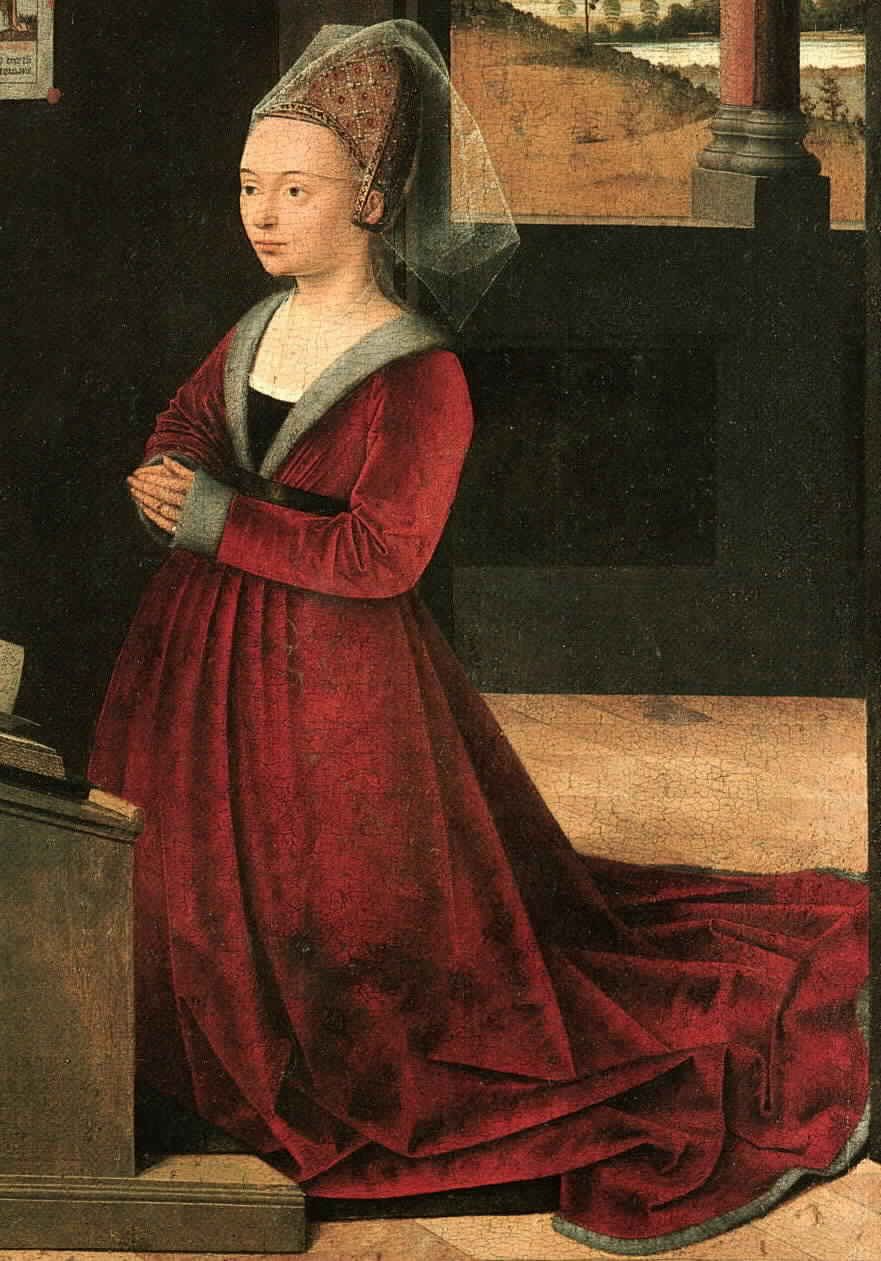
One other interesting structural mystery about these hats is the loop. What are they for? What are they attached to? You can see in the Memling picture here, showing ladies with loops but no hats, that the loops appear to be attached to headbands or something attached to the hair, not the hat. It might be that the hat sits over the loop/headband thing and attaches to it, with the loop acting as a counterbalance. This makes a certain amount of sense to me. When I was in college, I had to do a theatrical version of a horned hennin as part of my senior project and it was very difficult to counterbalance. I solved the problem with some creative shaping in the back of the hat, which looked ok but prevented me from turning my neck in certain directions. That same semester we had to make these big bubble-shaped head pieces based on the same hennin idea and solved the problem with little close fitting caps that went under the whole mess, so perhaps the loop-band is serving the same purpose.
Duchie Award!
I was reward to checking on all the blogs I like to follow today by finding out that Edyth at The Completely Dressed Anachronist nominated me for a Duchie Award! I now feel shamed into actually sewing something historical this week, not just making knitting needle cases and taking naps (why oh why am I so sleepy?!)
Anyway, the rules for receiving the Duchie Award are to post on your blog, in any order:
Cloths as experimental archeology - I think is this is more obvious as applied to medieval and earlier clothing, but the same can be said for later periods of fashion as well, but you get a better sense of how people actually lived when you try to live in their clothing. Literally walking a mile in their shoes gives you a whole new insight into how it was to live/sleep/eat as an Elizabethan, Victorian, Roman or whatever.
Attention to detail - Unless you are lucky enough to wear couture, modern clothing is mass produced usually in sweatshops. The finishing is sloppy at best. Sewing allows me to focus on the detail work, finishing things properly. Historical sewing opens up a whole new level of detail, not just finishing the seams and paying attention to details of fit, but doing it in different ways than we use today.
Gotta love a challenge - Everything about period costuming, from researching to pattern drafting to sourcing materials is challenging. Some things are certainly easier to do than others, but there is always a way to make it better, more authentic. Even a simple tunic can be a huge challenge if I want it to be, and that keeps me interested in what I'm doing.
Playing with colors - In real life I wear jeans and a lot of grey, browns and black. Sometimes I get crazy and throw some pink in there, maybe burgundy. When I create historical costumes I get to put aside what modern tastes say are fashionable, what "goes" and get creative. I can wear goose-turd green and pink and red all at the same time. Or crazy striped fabric that gives most people a headache, or red shoes with yellow stockings and blue garters. And this is fashionable. Plus I get to figure out how to do all this with plants, and that's just plain old cool.
Geek out!!- The best thing, if I have to pick just one best thing, about all of this, if that I get to geek out on stuff that I'm interested in. I like pretty things and playing dress-up, but I also like the technical parts of all this and figuring things out. It turns out there are people, and sort of a lot of them, out there who are just as geeky as me about weave structure and sheep breeds and dye materials and how to set a sleeve as I am.
And lastly (because I already did #3 at the very top), my nominees,
Demode - because Kendra is amazing. She makes beautiful cloths (not costumes, cloths) and does excellent research. Her focus is later period that what I've been doing of late, but it's still inspiring and I know where to go when I get around to making an 18th century gown!
The Costumers Closet - again with the mostly later period than me stuff, but the work is beautiful and really inspiring! I appreciate that she posts a lot of in-progress pictures so we can see how she's putting things together, something I aspire to do more faithfully.
Katie Jacobs - Lovely work, again later period, but more importantly she posts how-tos and sourcing tips, and other great information useful if you going to actually *wear* some of the cloths you have made to a reenactment. She gets the looks head-to-toe, which so many people miss.
Anyway, the rules for receiving the Duchie Award are to post on your blog, in any order:
- Five things you love about historical costuming
- At least three blogs to pass the Duchie Award onto
- A link back to the blogger who awarded you the Duchie
Cloths as experimental archeology - I think is this is more obvious as applied to medieval and earlier clothing, but the same can be said for later periods of fashion as well, but you get a better sense of how people actually lived when you try to live in their clothing. Literally walking a mile in their shoes gives you a whole new insight into how it was to live/sleep/eat as an Elizabethan, Victorian, Roman or whatever.
Attention to detail - Unless you are lucky enough to wear couture, modern clothing is mass produced usually in sweatshops. The finishing is sloppy at best. Sewing allows me to focus on the detail work, finishing things properly. Historical sewing opens up a whole new level of detail, not just finishing the seams and paying attention to details of fit, but doing it in different ways than we use today.
Gotta love a challenge - Everything about period costuming, from researching to pattern drafting to sourcing materials is challenging. Some things are certainly easier to do than others, but there is always a way to make it better, more authentic. Even a simple tunic can be a huge challenge if I want it to be, and that keeps me interested in what I'm doing.
Playing with colors - In real life I wear jeans and a lot of grey, browns and black. Sometimes I get crazy and throw some pink in there, maybe burgundy. When I create historical costumes I get to put aside what modern tastes say are fashionable, what "goes" and get creative. I can wear goose-turd green and pink and red all at the same time. Or crazy striped fabric that gives most people a headache, or red shoes with yellow stockings and blue garters. And this is fashionable. Plus I get to figure out how to do all this with plants, and that's just plain old cool.
Geek out!!- The best thing, if I have to pick just one best thing, about all of this, if that I get to geek out on stuff that I'm interested in. I like pretty things and playing dress-up, but I also like the technical parts of all this and figuring things out. It turns out there are people, and sort of a lot of them, out there who are just as geeky as me about weave structure and sheep breeds and dye materials and how to set a sleeve as I am.
And lastly (because I already did #3 at the very top), my nominees,
Demode - because Kendra is amazing. She makes beautiful cloths (not costumes, cloths) and does excellent research. Her focus is later period that what I've been doing of late, but it's still inspiring and I know where to go when I get around to making an 18th century gown!
The Costumers Closet - again with the mostly later period than me stuff, but the work is beautiful and really inspiring! I appreciate that she posts a lot of in-progress pictures so we can see how she's putting things together, something I aspire to do more faithfully.
Katie Jacobs - Lovely work, again later period, but more importantly she posts how-tos and sourcing tips, and other great information useful if you going to actually *wear* some of the cloths you have made to a reenactment. She gets the looks head-to-toe, which so many people miss.
Monday, October 10, 2011
12th Night Planning
I've spent the better part of the weekend being productive for the first time in what feels like a hundred years. It was wonderful. I made cornhole bags (don't ask), knitting needle cases, finished some embarrassingly backed up work from over the summer, and redesigned my jewelry web site. I've spent a huge amount of time at the sewing machine and the ironing board, and my leg does not hurt. Hurray! Sure, I got tired, but I lasted longer that I would have even before the surgery for we're on the right track.
Anyway, the theme for our kingdom's 12th Night is the Court of Maximilian I in 1500. So, German. Which sounds interesting, but not something I would be likely to wear again. However my persona is Flemmish, so that's close enough, and I've been wanting to do this red gown forever, and it dates to 1450 so, again, close enough. I have some red wool to make the gown out of, it's actually red shot with navy, kind of a tiny hounds-tooth, and ends up reading a really rich burgundy. It's a little light, so I may have to line it, but I have some burgundy linen I can use for the lining.
The collar and cuffs look to have a very short pile, my guess is it's fur. Finding a good low-pile fake fur is not going to be easy so I will probably just use velvet, hopefully in a silvery or cream color so it looks like the picture.
I'm really *really* excited about the hat. Especially since it isn't black. It sort of looks like the crown might be rounded too, but that might be a trick of the veil. I've got to decide how I want to build this thing, doing it with buckram will be easy enough but I'm not sure if that's how they were most likely made. It could also be a felt form that's been decorated. I doubt it's straw. At least I know what I need to research.
Anyway, the theme for our kingdom's 12th Night is the Court of Maximilian I in 1500. So, German. Which sounds interesting, but not something I would be likely to wear again. However my persona is Flemmish, so that's close enough, and I've been wanting to do this red gown forever, and it dates to 1450 so, again, close enough. I have some red wool to make the gown out of, it's actually red shot with navy, kind of a tiny hounds-tooth, and ends up reading a really rich burgundy. It's a little light, so I may have to line it, but I have some burgundy linen I can use for the lining.
The collar and cuffs look to have a very short pile, my guess is it's fur. Finding a good low-pile fake fur is not going to be easy so I will probably just use velvet, hopefully in a silvery or cream color so it looks like the picture.
I'm really *really* excited about the hat. Especially since it isn't black. It sort of looks like the crown might be rounded too, but that might be a trick of the veil. I've got to decide how I want to build this thing, doing it with buckram will be easy enough but I'm not sure if that's how they were most likely made. It could also be a felt form that's been decorated. I doubt it's straw. At least I know what I need to research.
Tuesday, October 4, 2011
Rijksmuseum digital exhibition
The Rijksmuseum in Amsterdam has launched a very cool digital exhibition called Accessorize. It's in flash and sort of a bandwidth hog, it loads fine for me over FiOS but your mileage may vary depending on your ISP. Anyway, it's worth whatever wait time! The exhibition covered accessories from 1550 to 1950 and you can drill down in the images to an insane level of detail. It's a bit late for my interests, but there are several pieces of gold work embroidery in the 1600-1650 section that are really stunning. There's lots of great inspiration, who doesn't love goldwork?
Friday, September 30, 2011
Healing!
So as you may have gathered I had surgery on my right hip about a month ago (late August, the day before Hurricane Irene came to town to be exact) and this has made much of my medieval crafting rather challenging for the last month. Because I could not put any weight on the leg, I could not spin or weave or drive my car, nor have been able to sit in a normal upright position for much of the month. The sitting part has been getting steadily better, I can now sit at the sewing machine for awhile anyway, though I have had to modify things at the ironing board so I can iron sitting down. Trying to iron on crutches is about ridiculous as it sounds (I tried, I really did). Staying in any one position for very long is still hard though, so I have not been making much progress on anything, which is is frustrating.
That should be changing though. They cleared me to start putting weight on the leg last week, and today the doctor said I could drive! Hurray! Such a small thing, but being house-bound for over a month has been really challenging. Just the psychological impact of knowing you can't go anywhere, never mind that you don't want to go anywhere or have anywhere to go, is pretty traumatizing. Tomorrow I get to give it a try, we need to be sure I can stop the car quickly if I need to, but all indications are that it should be fine. This also means I'm ok to spin at the wheel again, and work at the loom! Yay! So I can get back to working on the projects I want to be working on, at least in small bits.
Monday, September 26, 2011
Distractions
Things have been a bit quiet around here for the past couple of weeks, partly because I've not been doing a whole lot of anything productive, and partly because I've been a bit distracted by a very off-topic project. Outside of my historical crafty interests, I knit and make jewelry and am in the beginning stages of (hopefully) starting a small business selling some of these things (hence the etsy link you see on this site). Well...my mom took one of the jewelry pieces to a group she belongs to in California and long story short I'm going to be selling at a trunk show in November. Yay! So I've been trying to get my inventory built up, get a website with a shopping cart together, and get business card and all that fun stuff together, all while still hoping around on crutches and unable to drive. Oh, and also going to physical therapy three times a week.
You can see the fruits of my labor-so-far here, at www.follyandnonsense.com. If nothing else, there is a picture of Molly, my dog, modeling one of my dog sweaters on the home page. :)
Sunday, September 18, 2011
A&S 50: Nine: Learn to Weave – Basic Tabby Structure, Rigid Heddle Loom
Tabby, also called plain
weave, is the most basic of weave structures and a great place to start for new
weavers. For my first weaving project, I
decided I use to use the small 24 inch rigid heddle loom I already had, and
work with tabby (partly because rigid heddles work best for tabby and partly because
I had almost no prior weaving experience).
The basic structure is very
simple. The weft threads travel over
every other warp thread, alternating each row to create the weave. This can be achieved with finger manipulation
or needle weaving, but the rigid heddle makes manipulating the warp threads
much quicker and simpler, allowing the weaving to raise or lower the threads
all in one motion. The primary
disadvantage to this style of loom (aside from having only one heddle or shaft)
is that the heddle is free-floating and doubles as the beater, making it
difficult to maintain an even beat and keep the selvedges straight.
The cloth was tabby woven
using a rigid heddle loom at 10 DPI at the full loom width of 24 inches. After
weaving, the cloth was fulled in a washing machine. Pre-fulling, the weave was
quite open and relatively even, though some areas were packed more tightly than
others (this was my first major weaving project and the first time I had worked
with a wool warp, so there was a bit of a learning curve in this process).
After fulling, the weave evened out a great deal and packed down considerably.
By the end of the fulling and dyeing process, the warp and weft were barely
visible and a compact, water repellent fabric had been produced, as can be seen
in the finished piece. This is significantly thicker and denser than the cloth
used in the extant Dublin caps, but will serve as a useful warm layer at cold
and wet events.
Of the twelve caps and three
remnants of caps studied in Heckett, nine of the caps and two of remnants are
wool. All of the examples are tabby woven, with an even weave structure. All
but one are classified as having an open weave. The wool caps are woven at a
range of 12 to 23 warps per centimeter, with wefts ranging from 9 to 20 per
centimeter. The cloth for all of the caps is lightweight and quite fine, and
some of the silk is very delicate. At least some of the hoods seem to have been
purpose-woven on narrow warps. All of the wool caps analyzed in Heckett have
selvedges along two sides, while the silk caps all appear to have been cut to
size from wider pieces of cloth. Most have not been analyzed for dye, but of
those that have two were undyed, two showed traced of iron mordant.
Sources:
Heckett, Elizabeth Wincott. Viking
Age Headcoverings from Dublin. Royal Irish Academy, 2003.
Walton, Penelope Textiles, Cordage and Raw Fibre from 16-22 Coppergate,Council
for British Archaeology, London, England 1989.
Viking Silk Cap,
Yorkshire Museum
(http://www.historyofyork.org.uk/themes/life-in-viking-york/viking-silk-cap).
Crowfoot, Elisabeth. Textiles
and Clothing c.1150-c.1450. Medieval Finds from Excavations in London, 4.
London: Her Majesty's Stationery Office, 1992.
Sunday, September 11, 2011
A&S 50 Eight: Learn Tubular Tablet Weaving
For my second-ever tablet weaving project I decided to be ambitious (as usual) and challenge myself a bit by weaving tubular cords for small book bag. Such cords can be seen on a brick stitch pouch housed in the V&S and studied extensively by Master Richard Wymarc and several have been found used as seal tags and as strings for rosary beads (see Crowfoot and Myers).
The basic technique is quite simple - a few cards are threaded, usually all Z or all S, and all the weaving in carried out by always working from right to left (or left to right), carrying the weft thread under (or over) the work to create a tube. The band will spiral, or not, depending on which direction the weft is passed through the shed and whether you pass the weft over or under the band. Learning which combinations will produce the desired effect takes some experimentation, but a handy reference can be found in Cindy’s Myers article on the purse strings, at http://www.silkewerk.com/tabletweaving/tubular.html.
My purse strings suffer from some unwanted spiraling, which due to my lack of technical understanding at the time, I was not readily able to control. I now realize that the areas free of spiral alternating with spiral were likely due to changes in the direction the cards turned. Had I turned the cards consistently in one direction, or changed the way I passed the weft when I changed my turning direction, I would have had a more consistent cord. I am looking forward to experimenting more with this technique as the cords produced are quite attractive and could be useful for many purposes. Unlike fingerlooped cords, there is no restriction on the length of cord that may be worked so this would be an excellent way to produce miles and miles of lacing cords.
Sources:
Crowfoot, Elizabeth. Textiles and Clothing, c.1150-1450 (Medieval Finds from Excavations in London). Boydell Press, 2001.
Myers, Cindy. Tubular Tablet-Weaving; Identifying and reconstructing the hanging cord from a 14th century embroidered purse. (http://www.silkewerk.com/tabletweaving/tubular.html) Last accessed Sept. 11, 2011. Originally published in Spring 2008 issue of TWIST.
Bag 8313-1863. 14th cen. Victoria and Albert Museum, London. http://collections.vam.ac.uk/item/O115592/bag/
The basic technique is quite simple - a few cards are threaded, usually all Z or all S, and all the weaving in carried out by always working from right to left (or left to right), carrying the weft thread under (or over) the work to create a tube. The band will spiral, or not, depending on which direction the weft is passed through the shed and whether you pass the weft over or under the band. Learning which combinations will produce the desired effect takes some experimentation, but a handy reference can be found in Cindy’s Myers article on the purse strings, at http://www.silkewerk.com/tabletweaving/tubular.html.
My purse strings suffer from some unwanted spiraling, which due to my lack of technical understanding at the time, I was not readily able to control. I now realize that the areas free of spiral alternating with spiral were likely due to changes in the direction the cards turned. Had I turned the cards consistently in one direction, or changed the way I passed the weft when I changed my turning direction, I would have had a more consistent cord. I am looking forward to experimenting more with this technique as the cords produced are quite attractive and could be useful for many purposes. Unlike fingerlooped cords, there is no restriction on the length of cord that may be worked so this would be an excellent way to produce miles and miles of lacing cords.
Sources:
Crowfoot, Elizabeth. Textiles and Clothing, c.1150-1450 (Medieval Finds from Excavations in London). Boydell Press, 2001.
Myers, Cindy. Tubular Tablet-Weaving; Identifying and reconstructing the hanging cord from a 14th century embroidered purse. (http://www.silkewerk.com/tabletweaving/tubular.html) Last accessed Sept. 11, 2011. Originally published in Spring 2008 issue of TWIST.
Bag 8313-1863. 14th cen. Victoria and Albert Museum, London. http://collections.vam.ac.uk/item/O115592/bag/
Tuesday, September 6, 2011
Natural Dye Book
| I actually have the first edition of Wild Color, by Jenny Dean, and was quite pleased this morning to find out that there is a new, revised edition out now as the first one had gone out of print. This is a wonderful introductory book on natural dyeing. If you can only get one book on natural dyes, this would be the one to get! This book has been indispensable for all my natural dying experiments. That being said, the first edition had a few organizational issues which have hopefully been resolved in this new revision. I'm tempted to order the new version myself just to find out, the book really is that useful. A very nice chart telling you what mordants and assists work best with each plant is included on each page, with a color swatch giving you a general idea of what colors to expect from the plant, but in the first edition the key the symbols used was buried in a very strange place. The problem is easily solved with a bookmark or post it, but finding that key in the first place (or when you lose your post it) can be quite aggravating. You also need to read all the general instructions first! I know, I know, you want to jump right in and start working with that madder you got at Pennsic, but reading the general instructions at the start of the book will save you a huge amount of pain and suffering later on. Then you can read up on the specifics of your dye plant, and get to work. Dean does a good job of explaining the chemistry behind natural dying, and you need to have a basic understanding of this before you jump in. For the history buffs, there is a short chapter on the history of dyeing at the start of the book that is a good starting off point for future research, but this is really a how-to book, not an academic one. There is a lot of great historical information and period dye recipes available on the web to round out your A&S bibliography. |
Friday, September 2, 2011
Not quite back
My Greenland hood project and the finished lattice bag were picked up this morning and should be on their way to 30 Year where they will be included in the open A&S display on Sunday, rather than the triathlon on Saturday. It's not quite what I was hoping for, but at least people will still get to see my work, and hopefully give me some feedback, which is the whole point. And I am basically halfway there if I decide to do the pentathlon for KASF, which seems a whole lot less terrifying than it did last year at this time. My Laurel suggested that I try weaving some actual yardage, which I think would be a great project for that if I can find something within the right time period. Handweaving (at least on a 4 shaft loom) and the 15th century don't really go well together, unless I want to do more of the Greenland textiles. I'll think of something interesting to do, I just need to do it soon! With the holidays and all I want to get any big projects well in hand as soon as I can.
I'm terribly disappointed in myself for not being able to finish the documentation for the lampwork rosary I posted pictures of last week, but given how much pain I've been in since the surgery it's really not surprising. I don't know what I was thinking, expecting to write anything decent (or at all) while hopped up on percocet. Things are getting better though, so I expect the writing will start moving along soon. In the mean time, I've been doing some fairly mindless and totally modern knitting in between naps.
Subscribe to:
Posts (Atom)